Showing posts with label Electoral Politics. Show all posts

Wednesday, September 2, 2020

Faint Signs of a Bounce (The Road to 270, Take 7)

This post is a day late and it will also be very brief. Since the Republican convention ended, the mood in the media has been an anxious anticipation of a tightening race. But 5 days after the Republican convention ended, we are seeing only a modest bounce for the incumbent. Biden's lead in the Real Clear Politics polling average dipped from 7.8 points to 6.2 points. It currently stands at 6.5. And Biden's chances in Nate Silver's forecast dropped slightly from a high of 73% down to 68%. It currently sits at 70%. Trump has gotten a couple fo decent polls. One poll of Michigan by a Republican pollster had him up by two. And a national poll conducted by Emerson right after the convention showed Biden's lead down to two. But the cross-tabs on that poll showed some screwy results, like Biden winning the suburbs but losing the cities. More importantly, Morning consult released a new round of battle groun polling yesterday tha showed Biden up in every swing state except North Carolina, where he was two points behind. The only state that showed significant movement was Arizona, where Biden's lead went up to 10 points. Two new national polls are out this morning, showing Joe Biden up by seven and eight points, respectively. So with both conventions behind us and Labor Day upon us, Joe Biden maintains a clear lead in national polls. He also has the upper hand in the electoral college and just announced a massive haul of $300 million dollars raised in August. His campaign is doing great. The biggest news fo the week might be that Donald Trump has embraced the notion that recent violence in Kenosha and Portland is a harbinger of things to come in Joe Biden's America. It has apparently not occurred to him or his senior staff that these events have happened in Donald Trump's America. No matter. If this gambit was going to work, we would be seeing more movement in his direction. There will be a flurry of polls in the next week or so. But for now, I remain confident that Biden is the heavy favorite. And I'm not sure what moves Trump can pull to change that dynamic. 

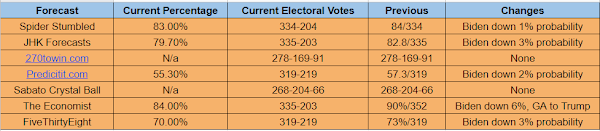
I. The Forecasts. I'm shaving one point of my forecast. I now give Biden and 83% chance of winning. I'm not flipping any states, so my official forecast is still Biden 319, Trump 219. Here is a look at how others see it:
II. The Paths. As the election gets in full swing, I thought it might be helpful to write a bit about what the most important states mean to the Biden campaign.
 
a. The Straightest Line. Hillary Clinton won 232 electoral votes. Her closest path to victory would have been to carry Pennsylvania (20), Michigan (16) and Wisconsin (11). Those three states would have gotten her to 278, but she lost each of them by less than one point. So the most obvious path for Biden is to do one point better in each of those states. 

But if something goes wrong, here is how he can make it up by winning something in the sun belt. 

b. The make-ups

If Biden loses Wisconsin (or Minnesota) he can make up for it by winning AZ, NC or FL.

If Biden loses Wisconsin AND Minnesota he needs to win FL or AZ AND NC. 

If Biden loses Wisconin (or Minnesota) and Michigan, he needs to win FL or AZ and NC. 

If Biden loses Michigan, he needs to win AZ, NC or FL. 

If Biden loses Michigan and Wisconin (or Minnesota), he needs to win any 2 among NC, AZ and FL. 

If Biden loses Michigan and Pennsylvania, he needs to win FL or NC AND AZ. 

If Biden loses Michigan, Pennsylvania and Wisconsin, he wold need to win FL plus NC or AZ. 

c. The quirks

For all of the above scenarios, GA could do the job of NC. I think Biden is more likely to win NC, but this could be a year that rearranges some things. Also must note that NH could throw a monkey wrench in some of these secnarios, but it's only 4 electoral votes and I think Biden will do well there.

Wednesday, May 21, 2014

As I Live and Breathe, It's Philadelphia Freedom

Dark blue states have marriage equality. Green states allow same-sex civil unions. Light blue states were carried by Obama but do not recognize gay relationships.  All of the red states were carried by Romney. At this moment, none have marriage equality or civil unions.

Yesterday I finally got around to updating my marriage equality map.  I did this primarily because Oregon had decided not to appeal a federal court decision to overturn that state's constitutional prohibition of gay marriages.  I fully expected the opposite outcome in Pennsylvania but today was pleasantly surprised to see that I was wrong.  The Republican governor of Pennsylvania announced  that he would not appeal the decision because such an appeal would be "extremely unlikely to succeed."

So that moves Pennsylvania to the dark blue on our chart. It is the nineteenth state to adopt full marriage equality.  At this moment, the nineteen states with full marriage equality have a total of  231 electoral votes.  If you add in the three states with other forms of legal recognition, those states have 256 electoral votes.  But there are nearly a dozen other states where the ban on gay marriages have been overturned by a judge. One such state is Michigan, the only state where Barack Obama got greater than 51% of the vote in 2012 that doesn't have at least some legal recognition of gay relationships.  Add just Michigan to the mix, and we will have a majority of states that recognize gay couples.  Add the other swing states like Virginia and Ohio and we sail past 300.  

The court battles will rattle around for several months at a minimum.  But the path is clear and we are beyond the point of no return.  Marriage equality is coming.


Tuesday, May 20, 2014

The Oregon Trail


Getting complicated, for now.
Last year saw a rapid expansion of marriage equality, often by state legislative action.  This year little has been achieved by legislatures because most of the remaining states have some kind of state constitutional limit on marriage equality and many of those states are run by Republicans.  So the action has turned to the courts with same-sex couples suing on the grounds that these state bans deny them their federal right to equal protection under the law.

The results have been unanimous.  Judges in states from across the political spectrum have ruled that bans on same-sex marriage are unconstitutional.  In most of these states the governor or attorney general has promptly stepped into to appeal the ruling and to ask for a stay of the opinion pending that appeal.  These appeals will take several months and when they begin to get decided, we could see different results form different courts.  Arkansas' ban was actually struck down in state court.  But their state supreme court may reverse it.  I suspect that most federal circuits will uphold the rulings of the district courts and strike the law down.

For this, we can thank Anthony Kennedy.  Last year he could have ruled to strike down the Defense of Marriage Act for a number of narrow reasons.  But his opinion was broad. He said that the law violated the freedom of a person under the Fifth Amendment.  Justice Scalia pointed out in his dissent that while the opinion only applied to the federal legislation, it would inevitably apply to state laws as well.  For once, Nino was right.  More than a dozen federal judges have looked at the issue in the past year and they all agree that state bans on marriage equality are impermissible.

I have not updated my marriage equality chart since December.  Back then only Utah's state ban had been struck down.  I turned Utah blue that proved premature as the state stopped issuing wedding licenses to gay couples after a few days.  The new map reflects four categories of states:

1. Eighteen blue states (plus DC) where Marriage Equality is a legal finality.  I have colored Oregon blue because the state has announced that they will not appeal the decision of the federal district court and an outside group was told they lack standing to pursue that appeal.  Gay marriage is alive and well in Portlandia, for good.

2.  Nineteen red states where marriage is still limited to heterosexual couples.  In the following months several of these states will probably flip to grey or blue because a number of cases are being litigated in these states.

3.  Ten grey states where the ban on gay marriages have been stuck down but the ruling is being appealed.  Some of these rulings are more narrow than a complete removal of the law from the books.  (For instance a judge has ruled that while Ohio has the right to only issue wedding licenses to straight couples, it must recognize gay marriages performed in other states.)

4. Three green states where gay relationships are offered some legal protection through either civil unions or domestic partnerships.

A plurality of Americans now live in the states with full marriage equality.  To put it in presidential election terms, these blue states have 211 votes in the electoral college.  The red states have 175 and the grey 127.  The three green states have 25.  A year from now, the various federal circuits will probably tip enough of the grey states into the blue category that a an outright majority of Americans will live in states that have full marriage equality.  Some of those appeals will go onto the Supreme Court.  If there is a substantial split among those circuit rulings, the court will have to take one of the cases.

The most likely outcome is that that case will be heard during the 2015/2016 court calendar. If the court is still constituted as it presently is, the court will most likely rule that no state has the right to deprive gay people of the right to marry.  And then I will celebrate by posting a sea to shining sea map of 50 blue states.